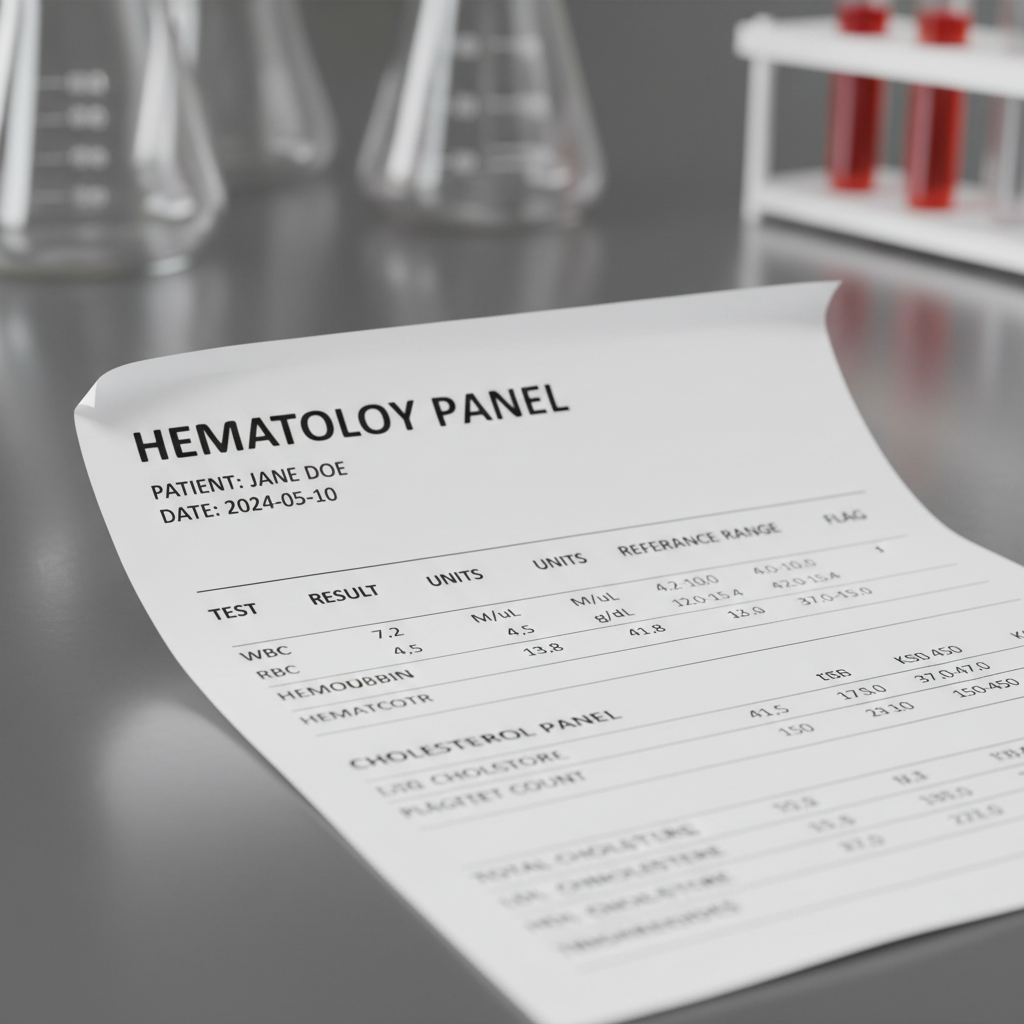
guide
Patient-Friendly
What Your CBC Results Actually Mean
A walk through every line on your complete blood count — hemoglobin, hematocrit, MCV, RDW — in plain language with reference ranges explained.
8 min readRead
Blood disorders explained in the language your body already knows.

MD, Hematology & Internal Medicine
Johns Hopkins Hospital, Baltimore
How it works
When your body doesn't have enough iron, it can't make hemoglobin — the protein that gives red blood cells their oxygen-carrying capacity. Think of it like a factory that's run out of its main raw material.
Iron deficiency anemia is the most common blood disorder in the world, affecting roughly 1.2 billion people. Your hematologist's report might show a low ferritin level — that's your iron storage reading, like checking how much fuel is in the reserve tank.
The good news: most iron deficiency responds well to treatment. Whether that's dietary changes, oral supplements, or IV infusions depends on how empty that tank is and why it got that way.
Key Numbers
<12 g/dL
Anemia threshold (Hgb)
<30 ng/mL
Low ferritin

MD, PhD — Coagulation & Thrombosis
Mayo Clinic, Rochester
How it works
Clotting is one of the body's most precise systems — a cascade of proteins that activates in sequence, like falling dominoes, to stop bleeding. When one domino is missing or moves too fast, you get either excessive bleeding or dangerous clots.
Conditions like hemophilia mean a key clotting factor is absent. DVT and pulmonary embolism mean clots are forming where they shouldn't. Your platelet count on a CBC report tells us how many of those tiny first-responders are available.
What I tell every patient: your body isn't broken. It's working with incomplete information. Our job together is to give it what it needs.
Key Numbers
150–400
Normal platelet range (K/μL)
<50K
Thrombocytopenia

MD, Hematologic Oncology
Memorial Sloan Kettering Cancer Center
How it works
A blood cancer diagnosis lands differently than most. The words — leukemia, lymphoma, myeloma — carry enormous weight before you've had a chance to understand what they actually mean for your specific situation.
Here's what I want you to know first: these are not all the same disease. Chronic lymphocytic leukemia in a 70-year-old may require watchful waiting rather than immediate treatment. Hodgkin's lymphoma has one of the highest cure rates in oncology. Context is everything.
The CBC numbers your oncologist showed you — blasts, lymphocytes, white cell count — are the beginning of a conversation, not its conclusion. You're allowed to ask what each number means, and you're allowed to bring someone with you to take notes.
Key Numbers
85–90%
Hodgkin's 5-yr survival
> 20%
Blasts = leukemia threshold
Over 200 illustrated guides written at a 7th-grade reading level, reviewed by board-certified hematologists. No jargon walls. No paywalls.
Browse the Blood LibraryTell us your name and your condition. We'll send a plain-language PDF guide — the kind you can print, fold, and bring to your next appointment. No medical degree required to understand it.
Every resource is written at a reading level you choose — from patient-friendly overviews to clinical references for nurses building discharge folders.
A walk through every line on your complete blood count — hemoglobin, hematocrit, MCV, RDW — in plain language with reference ranges explained.
Illustrated guide to vaso-occlusive pain crises — why they happen, what triggers them, and the language to use when describing your pain to the ER team.

For patients on anticoagulation therapy — what your INR number means, why it fluctuates, and when to call your anticoagulation clinic.

Neutropenia, thrombocytopenia, anemia — the three most common blood count changes during chemo, and what precautions matter most at each stage.

Parents and patients often confuse these two. This guide explains the genetic difference, what each means for daily life, and what to tell your children.

For patients with clotting disorders or recent hospitalization — the symptoms that require immediate attention and why they happen.

Stage I through Stage IV — what these numbers actually mean for treatment planning, and why a higher stage does not always mean a worse outcome.

For patients who've been prescribed IV iron — a step-by-step walkthrough of the procedure, common side effects, and when to contact your care team.